

In Can Tho, experiential activities in craft villages combined with cuisine are being promoted, thereby diversifying local tourism offerings.
Promoting the values of craft villages and cuisine
Cuisine tells stories of history, terroir and indigenous customs through its ingredients and flavors. At the same time, traditional craft villages serve as vibrant living heritage sites, where tourists can observe the exquisite craftsmanship of artisans and directly experience the product-making process. The combination of culinary specialties exploration and craft village experiences helps diversify tourism activities, boosts visitor spending, and contributes to preserving and promoting indigenous culture.
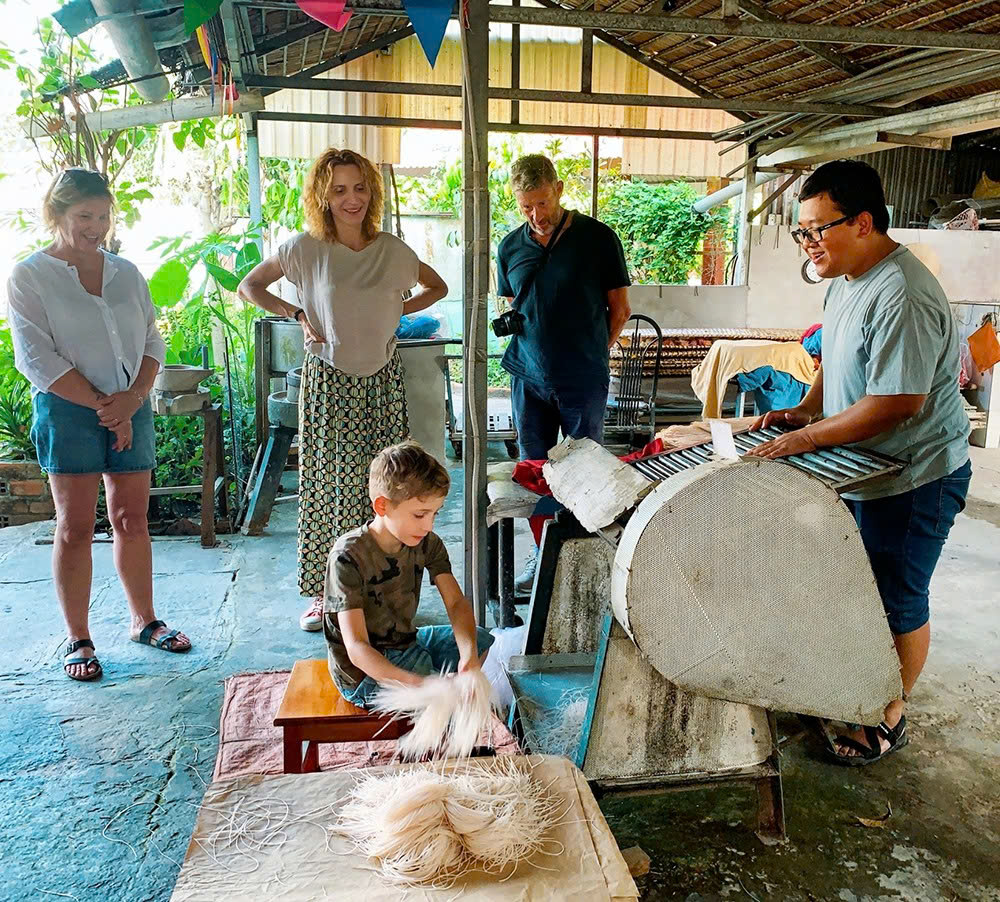
International tourists experience noodle making at Sau Hoai's Pizza Hu Tieu Factory. Photo: KIEU MAI
Ms. Truong Thi Bach Thuy, Director of Thuy Tuyet Bamboo and Rattan Weaving Cooperative in Thoi Hoa Commune, said: “Our village is more than just a bamboo and rattan weaving village. It is also a place that preserves cultural features, Khmer dances and the diverse cuisine of the Kinh, Hoa and Khmer ethnic groups”.
At Thuy Tuyet Bamboo and Rattan Weaving Cooperative, visitors are instructed by artisans to weave handicraft products and can take their finished products home as souvenirs; they can also make banh xeo, banh cong and banh tieu themselves. If staying longer, visitors can also watch and learn Khmer dances. Ms. Truong Thi Bach Thuy noted that every destination has its own distinct cultural traits, customs and way of life. Thus, integrating tourism experiences with craft villages and cuisine helps breathe new life into the area and showcase its beauty.
Likewise, to keep traditional craft villages from fading away, many locals have turned to tourism. A typical example is Mr. Huynh Huu Hoai, owner of Sau Hoai's Pizza Hu Tieu Factory in An Binh Ward. According to Mr. Sau Hoai, a few decades ago, his neighborhood was known for its dozens of hu tieu (a southern Vietnamese rice and tapioca noodle soup) workshops, but as time went by, the number of families preserving the trade dwindled. Driven by a desire to preserve the traditional craft of making hu tieu, he boldly switched to tourism.
He retains traditional manual steps, allowing tourists try their hand at steaming rice sheets, sun-drying and cutting the noodles... Meanwhile, combining rice-made hu tieu with braised pork and coconut cream that carries the flavor of the Mekong Delta, Mr. Sau Hoai went on to create hu tieu pizza with a crispy fried noodle base formed like a Western pizza. This unique fusion piques curiosity and draws tourists, particularly international visitors.
Revitalizing craft village and culinary experiences
Integrating craft villages and local cuisine into tourism requires investment and creativity in how experiences are organized. Ms. Nguyen The Ngoc, Director of Ngan Long Home & Camp - Con Son (Binh Thuy Ward), said: “In our programs, we always combine culinary experiences and folk cake making. We seek out older artisans who still keep the traditional ways, bringing along cake-making tools from decades ago for tourists to experience”.
According to Ms. Nguyen The Ngoc, for traditional cakes and local cuisine to reach a wider audience, creativity and suitable adaptations are needed to pique curiosity. For instance, folk cakes can be given added colors from natural ingredients such as pandan and magenta leaves. In this way, visitors can experience harvesting leaves and creating colors while learning about native plants and the lifestyle of the Mekong Delta, and the traditional cakes themselves become more visually appealing.
Similarly, Ms. Huynh Thi Bich Tuyen, Director of Mekong Silt Ecolodge (An Binh Ward), said that experiential activities should be organized flexibly, keeping the original features while having a suitable presentation. With traditional craft villages, in addition to taking tourists to have hands-on experiences at local households, the establishment also hosts workshops to revive crafts that have disappeared or are now followed by only a few people. Regarding cuisine, Ms. Huynh Thi Bich Tuyen weaves cultural stories into each dish, from banh phu the and grilled bananas to grains of rice, shrimp, and fish from the rivers of Can Tho and the Mekong Delta.
Ms. Huynh Thi Bich Tuyen shared: “We are enhancing the value chain of indigenous cuisine, putting it in a new context and with a new mindset. It’s still mangrove apple hotpot, but when we tell the story of the tree species that holds the land for local people, the value becomes different, especially when guests take a boat ride to see the sonneratia trees and pick the fruit to cook”.
Leveraging the value of cuisine and traditional craft villages also creates opportunities to generate livelihoods and enhance living standards of local residents. Ms. Pham Thi Thuy Diem, owner of Co Hai Homestay in An Thanh Commune, shared: “With the desire to breathe new life into craft villages as well as to create stable livelihoods for local people, I have recently collaborated with potential craft villages and households to develop tourism in An Thanh and Cu Lao Dung communes. From there, we have initially built experiential routes featuring distinctive craft villages and cuisine, while also creating unique local culinary products”.
In addition to craft village experiences, at Co Hai Homestay, tourists can also try making banh num co - a local specialty cake - with artisans, or taste mangrove apple fruit products like flower tea, candy, salad and more.
Combining craft village tourism with culinary experiences not only boosts economic value for the community but also paves the way for sustainable development.
AI LAM (Translated by MAI QUYEN)
Ý kiến bạn đọc